
Conceptions of justice underpinning Europe’s policies towards the Israeli-Palestinian conflict
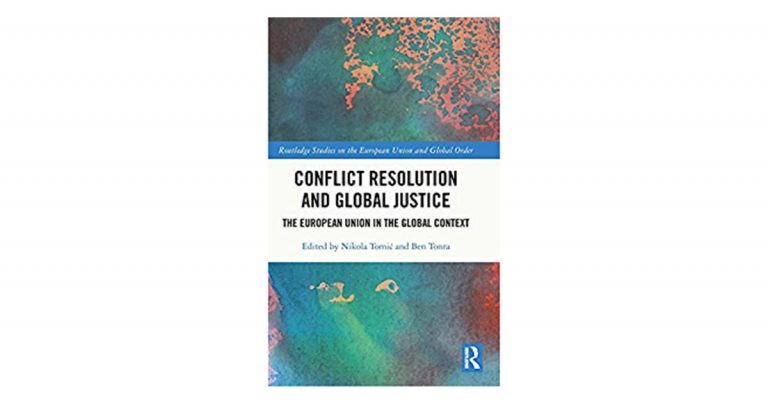
Conceptions of justice underpinning Europe’s policies towards the Israeli-Palestinian conflict
Ever since the Venice Declaration (1980), the European Union (EU) has pursued a just solution for the Israeli-Palestinian conflict as one of its foreign policy priorities. From the EU’s point of view, this entails the creation of an independent, democratic, and viable Palestinian state living in peace with neighbouring Israel.
Drawing on the normative international political theory, I conduct both deontological and consequential evaluation of how just the EU’s approach to the Israeli-Palestinian conflict has been over the years. My starting assumption is that EU’s own conception of a “just solution” primarily concerns norms of “justice as non-domination” and “justice as impartiality” while less so the norm of “justice as mutual recognition”.
From the consequential point of view, however, the EU’s approach has been far less just in effect. Despite its intentions, the EU actions have not contributed much to “justice as non-domination” and have maybe even propped up the Israeli domination and discrimination of the Palestinian people by bearing the costs of its prolonged occupation.
When it comes to “justice as impartiality” the EU’s track record has been mixed as it has somewhat improved human rights protection of the Palestinian people although it has also propped up an authoritarian rule of the Palestinian Authority.
Finally, in terms of “justice as mutual recognition”, the EC/EU has probably had the most success by legitimising the Palestinian struggle for self-determination at the international scene, although this process remains incomplete.
Democratic Security Sector Governance in Serbia
Democratic Security Sector Governance in Serbia
DOWNLOAD RELATED DOCUMENTS
Memories of Empire and Entry into International Society
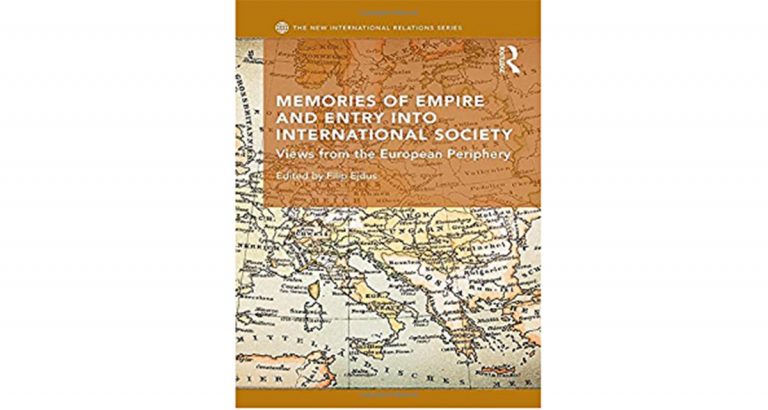
Memories of Empire and Entry into International Society: Views from the European periphery
What is the role of memories for the expansion of international society? By drawing on the English School approach to International Relations this edited volume argues that the memories of empire and suzerainty are key to understanding sociological aspects of the expansion of anarchical society.
The expert contributors adopt a socio-historic conceptualization of entry into international society, aiming to move beyond the legalist analysis, and also explore the impact of identity-constructions and collective memories on the expansion of international society.
Empirically, the volume investigates the entry into international society of Belarus, Bulgaria, Greece, Poland, Serbia, Slovakia and Romania and studies memories that they activated along the way.
While these memoires of bygone polities were used by state builders to make sense of international society and legitimise claims of the new entrants, they inadvertently also generated tensions and anxieties, which in many ways persist until this day. Both the theoretical angle and the empirical material presented in this book are novel additions to the growing body of knowledge in historical International Relations.
Exploring how memories and experiences of the past still complicate the entrants’ positions in the international society and to what degree ensuing tensions remain today this volume will be of interest to all students and scholars of European International Relations, particularly those with a focus on Eastern Europe.
Forthcoming June 2017 with Routledge.
For more details click here:
Violent Extremism in the Western Balkans
Violent Extremism in the Western Balkans
Collection of papers presented at the PfPC workshop held in Belgrade co-edited by Predrag Jureković.
DOWNLOAD RELATED DOCUMENTS
Rečnik evropske bezbednosti
Rečnik evropske bezbednosti, Beograd: Centar za civilno-vojne odnose, 2010
DOWNLOAD RELATED DOCUMENTS
Pojmovnik bezbednosne kulture
Pojmovnik bezbednosne kulture (sa Svetlanom Stanarević), Beograd: Centar za civilno-vojne odnose, 2009.
DOWNLOAD RELATED DOCUMENTS
Serbia and Croatia
Serbia and Croatia
During the cold war, the Socialist Federative Republic of Yugoslavia was a middle-sized power pursuing a non-aligned foreign policy and a defence strategy based on massive armed forces, obligatory conscription, and a doctrine of ‘Total National Defence’.
The violent disintegration of Yugoslavia in the early 1990s resulted in the creation of several small states. Ever since, their defence policies and armed forces have been undergoing a thorough transformation. This chapter provides an analysis of the defence transformation of the two biggest post-Yugoslav states—Serbia and Croatia—since the end of the cold war.
During the 1990s, defence transformation in both states was shaped by the undemocratic nature of their regimes and war. Ever since they started democratic transition in 2000, and in spite of their diverging foreign policies, both states have pivoted towards building modern, professional, interoperable, and democratically controlled armed forces capable of tackling both traditional and emerging threats.
The Impact of Turkey and the Gulf States
The Impact of Turkey and the Gulf States
DOWNLOAD RELATED DOCUMENTS
Diskurzivna i praktična konstrukcija međunarodne (ne)bezbednosti
“Diskurzivna i praktična konstrukcija međunarodne (ne)bezbednosti“ (str.199-229) u Dejan Jović, Konstruktivističke teorije međunarodnih odnosa, FPZ, Zagreb, 2016.
DOWNLOAD RELATED DOCUMENTS