Home Blog

From Pentagon to Classroom: RAND’s Hedgemony as a Pedagogical Tool in Graduate IR and Security Studies

0

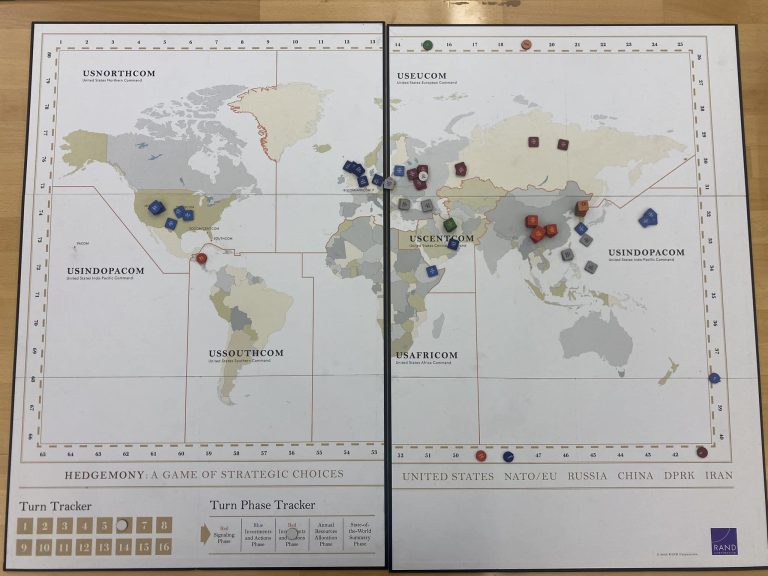
Since its founding, most of the games for which the RAND Corporation has been known were either strictly confidential or too complex to be used in a university setting. In 2020, RAND transformed a game originally created for the US Department of Defense into a commercially available version: Hedgemony: A Game of Strategic Choices. Our aim in this article is to review the game, assess its pedagogical potential, and suggest ways it can be used in an IR classroom. To that end, we first present and critically review the game. Second, we explain how we prepared and adapted the scenario for play with our graduate students at the University of Belgrade. Third, we describe how our game sessions unfolded. Fourth, we assess the pedagogical effects of the game in the IR classroom. Finally, we offer critiques of the game and consider how some of its limitations might be creatively addressed by players. We conclude that the game’s versatility significantly enhances student engagement, knowledge retention, and the comprehension of abstract concepts.

KEYWORDS: Hedgemony; RAND;wargames; pedagogy; IR

Article co-authored by: Ejdus, Filip, Đorđe Krivokapić, Rastko Popović, Marko Kovačević,Milan Varda and Aleksandra Ilić-Rajković and published in Journal of Political Science Education (2026) https://doi.org/10.1080/15512169.2026.2612711

Full article us available here: https://www.tandfonline.com/doi/epdf/10.1080/15512169.2026.2612711?needAccess=true

Hedgemony Teaching Resources Repository

0

Welcome to the Hedgemony Teaching Resources Repository


On behalf of the Serious Games Lab of the Center for International Security I am making available a set of supporting materials for educators, students, and players interested in using Hedgemony: A Game of Strategic Choices in the classroom (RAND 2020).


This repository contains three types of resources:


1. Explainer videos – recorded gameplay and walkthroughs of the game’s core elements. Since neither RAND’s website nor YouTube currently provide full gameplay demonstrations, these videos offer a practical introduction for new players. Available at: https://drive.google.com/drive/folders/11MQ20wkymlBP77Q3NTj4NkdYNWwwxvBm?usp=sharing

2. The new scenario – a collection of over 20 new action, investment, and event cards (domestic and international), as well as an entirely new scenario built around the Russian invasion of Ukraine (beginning on 24 February 2022). Available at:  https://drive.google.com/drive/folders/1TCv6Lf3uORur5ipakvbNH_FUKKkKILi4?usp=sharing

3. Hedgemony explainer – a concise guide designed to help new players quickly grasp the basic rules and mechanics. Available at: https://docs.google.com/document/d/1CAYIbnDUX02JBrSZf3J1GIGQwa3wzNkn/edit?usp=sharing&ouid=113160824103442565022&rtpof=true&sd=tru


These resources are intended as supplements to the official game materials provided in the Hedgemony box, including the rulebook, player’s guide, abbreviations, and glossary. Our aim is to enrich the pedagogical use of the game, making it more accessible to students and adaptable to contemporary international security challenges.


We invite you to explore the links above and use these resources in your teaching, learning, and gameplay.

Catharsis, rearticulation of desire and ontological insecurity: The case of Serbia’s attachment to Kosovo

Abstract

One of the central insights of critical and constructivist International Relations (IR) scholarship is that identity-seeking matters in world politics. Ontological Security Studies (OSS) has expanded on this insight, emphasising that actors may prioritise maintaining a stable sense of self over physical security and other concerns. Yet the question of radical identity change, particularly its affective dimension, remains underexplored. To address this gap, we draw on Lacanian psychoanalysis and argue that ontological security is sustained by fantasies aimed at filling a primordial lack that can never be resolved. This lack generates anxiety, which actors attempt to soothe by attaching their desires to empirical signifiers – objects-cause of desire – that promise wholeness. Our argument centres on the idea that the rearticulation of desire occurs through the affective mechanism of catharsis, manifesting as either metaphor or metonymy. We illustrate our argument through the case of Serbia’s cathartic (re)articulation of Kosovo as its object-cause of desire. In particular, we juxtapose earlier successful articulations of Kosovo as a metaphoric substitution for other desires with more recent, less effective attempts to rearticulate the north of Kosovo and the submerged cultural heritage in Gazivode Lake as metonymic substitutions for the rest of the territory.

This article is co-authored with dr. Marina Vulović and published OA in Review of International Studies https://www.cambridge.org/core/journals/review-of-international-studies/article/catharsis-rearticulation-of-desire-and-ontological-insecurity-the-case-of-serbias-attachment-to-kosovo/2A7622D4F8960CFD39F6F050AFC89CE3

Building an international relations journal from scratch and from the margins: the case of Journal of Regional Security

This article analyzes the path of establishment of the Journal of Regional Security (JRS), an open-access journal which was built from scratch by a group of scholars interested in security and peace in the Western Balkans. The article shows that a successful building of an International Relations journal from scratch on the semiperiphery requires not only long-term commitment with slow and uncertain payoffs but also a lot of creativity and flexibility. Initially, the article delves into the Journal’s history, situating it within broader institutional and sociopolitical contexts that have shaped its development. Subsequently, it examines how JRS has positioned itself on the semiperiphery and within the emerging global International Relations program. The third section discusses effective strategies employed by the editorial team to navigate International Relations hierarchies and rankings, emphasizing creativity, innovation, networking, and dedication to the journal’s mission. Finally, it concludes by addressing the challenges and opportunities faced by JRS, suggesting that despite being a small, independent journal operating in a semiperipheral context, it can leverage its unique position to its advantage.

The article coathored with Marko Kovačević, Nemanja Džuverović and Rok Zupančič is available at https://link.springer.com/article/10.1057/s41304-025-00532-w

Spinning and Hedging: Serbia’s National Security Posture

0

Ejdus (2024) spinning and hedging The full paper is available here https://newlinesinstitute.org/political-systems/spinning-and-hedging-serbias-national-security-posture/


G-Dem – The geo(politics) of democracy in the Western Balkans

0

This project has received funding via the EUI Widening Programme call 2025. The EUI Widening Europe Programme initiative, backed by contributions from the European Union and EUI Contracting States, is designed to strengthen internationalisation, competitiveness, and quality in research in Widening countries, and thus foster a more cohesive European Higher Education and Research area.

The democratic decline has almost exclusively been studied as the result of unsuccessful democracy promotion, rather than as an outcome of strategic approaches to the global competition for power. The recent victory of Donald Trump in the US Presidential race, Vladimir Putin’s growing ambition to destabilise the EU and the NATO, and the economic rise of Xi Jinping’s China have massive implications on how democracy is understood and practiced by local political actors in the Western Balkan states. The tectonic change in the global geopolitics after Russia’s full-scale invasion on Ukraine in February 2022 thus calls for an urgent investigation of the impact of external actors on democracy and autocracy promotion. The G-Dem research project studies under what conditions do the democratising external actors bring about democratic decline, and when do the autocratic ones have the highest leverage for de-democratisation.

To identify these conditions, and theorise about them, G-Dem develops an innovative analytical framework for studying the geopolitics of democracy. It consists of :

(1) a three-level understanding of external actors’ goals and strategies in different geopolitical contexts (global, regional, local);

(2) a systematisation of the mechanisms of influence (political, economic, cultural); and

(3) a typology of effects on the institutions and values of democracy.

The decoupling of geopolitical actors’ objectives across contexts has an important analytical value, as they entail different strategies, tools, and outcomes. For instance, Russia’s global objective is geopolitical primacy, through territorial expansion. In the Western Balkan region, this strategy takes the shape of providing an alternative to EU integration by leveraging on political and economic dependencies; in individual countries, it ranges from supporting secessionist agendas (Bosnia and Herzegovina), to disinformation campaigns (Kosovo, Serbia), to hybrid threats (Montenegro). Each of these strategies has a different outcome on local democracy: the global one deepens the polarization over values associated with the ‘East’ and the ‘West;’ the regional one cements local oligarchies and their patronage networks, and the local ones challenge the stability of democratic institutions.

To offer a systematic empirical study of the impact of geopolitics on democracy in the Western Balkan states, G-Dem builds up a collaborative research network. Using a bottom-up and context-sensitive approach to research, country experts will provide two types of input:

(a) individual country studies, based on content analysis of government policy and legislative documents, as well as interviews with policymakers and civil society representatives; and

(b) responses to a questionnaire on the political, economic and cultural mechanisms of influence of external actors.

The country reports and questionnaire results will serve as the basis for the comparative cross-regional analysis, which is intended to lay the pillars for a multiannual collaborative research agenda that uses insights from the Western Balkans to reshape the ways we think about the linkages between power, territory, individuals, and institutions.

Website: https://www.eui.eu/research-hub?id=the-geopolitics-of-democracy-in-the-western-balkans
Filip Ejdus

0

Hi!

I am a scholar of International Relations, with research focus in international security.

Most of my research investigates how identity, memory and emotions affect security dynamics in world politics. In addition to this I have studied international interventions,  civil-military relations, security sector reform, regional cooperation, geopolitics, neutrality, peace-building, extremism, social mobilisation etc.

The geographic focus of my interests are the EU, Western Balkans (particularly Serbia/Kosovo) and Israel/Palestine.

I am currently serving as co-Editor in Chief of Journal of Regional Security, co-chair of the Regional Stability Study Group at the Partnership for Peace Consortium and President of Central and Eastern European International Studies Association (CEEISA).

Crypto-Atlanticism: Policy Elites and Neutrality in Europe

0


Soon after Russia invaded Ukraine on 24 February 2022, Sweden and Finland, long-standing militarily neutral and non-aligned states, swiftly applied for NATO membership. How can such a quick shift be understood? The research Catherine Hoeffler and I conducted within a larger project on policy elites’ preferences in European states on the eve of the war in Ukraine (2020-2022) and which was published in Contemporary Security Policy, might provide some answers to this puzzle. 


Full blog is available here: https://www.cips-cepi.ca/2024/12/06/crypto-atlanticism-policy-elites-and-neutrality-in-europe/

The Ostrich Effect: What the Serbian Public Knows, Doesn’t Know, and Avoids Knowing About the Brussels/Ohrid Agreement

0


This brief shows how Serbian public reacted to this set of events. To this end, a public opinion poll was conducted from July 1 to 9, 2023. The poll, conducted by Sprint Insight, was a faceto-face, door-to-door survey carried out on a representative, stratified sample of 1,213 respondents across Serbia (excluding Kosovo). Our main finding is that, despite a strong attachment to the idea of Kosovo as part of Serbia and its central role in Serbian national identity, the majority of Serbian citizens are not only unfamiliar with the agreements concluded in Brussels and Ohrid but appear to prefer not to know much about them. Moreover, the findings also suggest that individuals with lower levels of overall understanding of the Kosovo issue, or of specific agreements, are less likely to perceive their national identity as being threatened in this context. Based on this, we tentatively conclude that there is an “Ostrich Effect” in the Serbian public opinion regarding Kosovo since its important segment prefers not to learn about the realities of the Kosovo issue in order to protect their emotional and cognitive belief that Kosovo remains part of Serbia.


The full text is available here https://mindproject.ac.rs/docs/the-ostrich-effect.pdf