Policing Palestine
Over the past month, the issue over access to the Al-Aqsa Mosque in Jerusalem caused a new wave of violence and confrontation that has swept over the West Bank. As a result of the new Israeli security measures in Jerusalem, including adding metal detectors to the Temple Mount (al-Haram al-Sharif) where Al-Aqsa is located, Palestinian President Mahmoud Abbas announced on July 23 that the Palestinian Authority (PA) would suspend security coordination with Israel, although there have been no signs yet this suspension is being implemented. In turn, and to show its dominance, Israel took some additional punitive measures, such as raiding offices of Palestinian inspectors in Hebron, announcing the expansion of new illegal settlements near Bethlehem, and arresting more Palestinians, especially in Jerusalem.
The situation has generated fears among the international community of another intense round of violence and confrontation that could, as in the past, threaten billions of dollars of investments in the Palestinian state-building project over the last decade. The international donor community remembers well when the EU-funded premises, equipment, and PA infrastructure were flattened by the Israeli incursion of the West Bank during the second intifada.
In case of further escalation, there is little doubt that international investments in security sector reform would suffer. This is a particular worry for the EU, which is the biggest donor to the Palestinian Authority and whose police mission there—the European Union Police Mission for the Palestinian Territories (EUPOL COPPS)—prides itself on reforming and overhauling major elements of the Palestinian security establishment and enhancing effective policing.
On July 4, the European Council extended the mandate of EUPOL COPPS until June 2018. The mission was originally launched in 2006 as part of the EU’s Common Security and Defense Policy (CSDP) in support of the Quartet on the Middle East’s roadmap for peace. The mandate of the mission is to support sustainable and effective policing under Palestinian ownership and in accordance with international standards. The technical support provided by EUPOL COPPS to security and justice reforms was expected to lead to Israel’s improved trust in the PA’s ability to ensure law and order. In turn, Israel’s increased security was meant to pave the way for a viable and democratic Palestinian state.
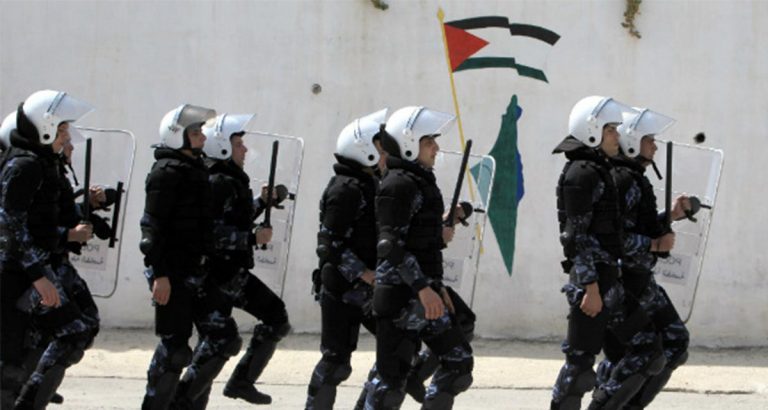
From the technical point of view, the mission managed to professionalizethe Palestinian Civilian Police (PCP) through capacity-building programs, local and international training, better vehicles and equipment, and contributing to hard and soft policing infrastructure (such as traffic cameras, and drug-control programs, and police stations). The mission has also achieved limited success on judicial reforms by providing technical support and advice to the Ministry of Interior, the Ministry of Justice, the High Judicial Council, the Attorney General’s Office, the Palestinian Anti-Corruption Commission, and the Palestinian Bar Association. In partnership with other donors, the EU and its mission helped the PA to re-establish civil and security control in parts of Area A of the West Bank.
Despite its initial reluctance to allow the EU to play a more significant political role in the region, Israel has endorsed these technical achievements of EUPOL COPPS, realizing the mission can make the PA more effective in policing the West Bank and a more reliable partner in quashing dissent and countering insurgency. Israel perceives EUPOL COPPS as an integral component of the security coordination paradigm that is mainly designed and structured to ensure Israelis’ security. It has kept the upper hand by determining what sort of equipment and training the PA police are allowed.
From the political point of view, however, the mission has achieved little. Over the last decade, the mission has indeed carved the EU a niche in Palestinian security sector reform and increased its visibility in the Middle East peace process. And for the PA, the mission managed to balance the dominance of the United States, traditionally seen as pro-Israel, as a sponsor of security sector reform. Nevertheless, the EU’s strategy to use EUPOL COPPS to pave the way for the democratic and viable state by building its security capacities has fallen short. Instead of reassessing that, the EU insists that the mission has a solely technical mandate.
However, the mission cannot escape the political aspect of the conflict, nor the political ramifications of its technical intervention. While the EU generally refrains from supporting security services with a reputation for human rights abuse, such as the U.S.-sponsored Preventive Security agency and the General Intelligence Service, the EU-supported Palestinian Civil Police (PCP) has also been implicated in the excessive use of force against peaceful demonstrations. Consequently, Palestinians increasingly see the EU support as part of a plot to maintain the occupation by proxy.
Furthermore, many Palestinians fear that the ultimate goal of the European and U.S.-led security sector reform of the Palestinian Authority is to silence or criminalize resistance against the Israeli occupation. According to this growing sentiment, this repression results directly from using international aid funds to subcontract the Israeli occupation to the PA. In the words of one inhabitant from the Jenin refugee camp who had been detained by Israel and the PA for the same charges, “The U.S. security mission is the big and aggressive devil; the European security mission is the small and gentle devil. Both of them are devils, but packaged differently.1”
The EU and its mission are increasingly becoming complicit in the maintenance of the status quo. If the current authoritarian backslide of the PA continues, the EU and its mission will be increasingly criticized for financing, professionalizing, and legitimizing a highly politicized and democratically unaccountable police force. This is a polar opposite of the EU’s foreign policy values and far from its own envisioned approach to security sector reforms.
Filip Ejdus is Marie Curie Fellow at the School of Sociology, Politics, and International Studies at the University of Bristol. Follow him on Twitter @FilipEjdus. Alaa Tartir is the program director of Al-Shabaka: The Palestinian Policy Network and a research associate at the Center on Conflict, Development, and Peacebuilding (CCDP) at the Graduate Institute, Geneva. Follow him on Twitter @alaatartir.
Article available on carnegieendowment.org